What to do about THE UNREMEMBERED WORD
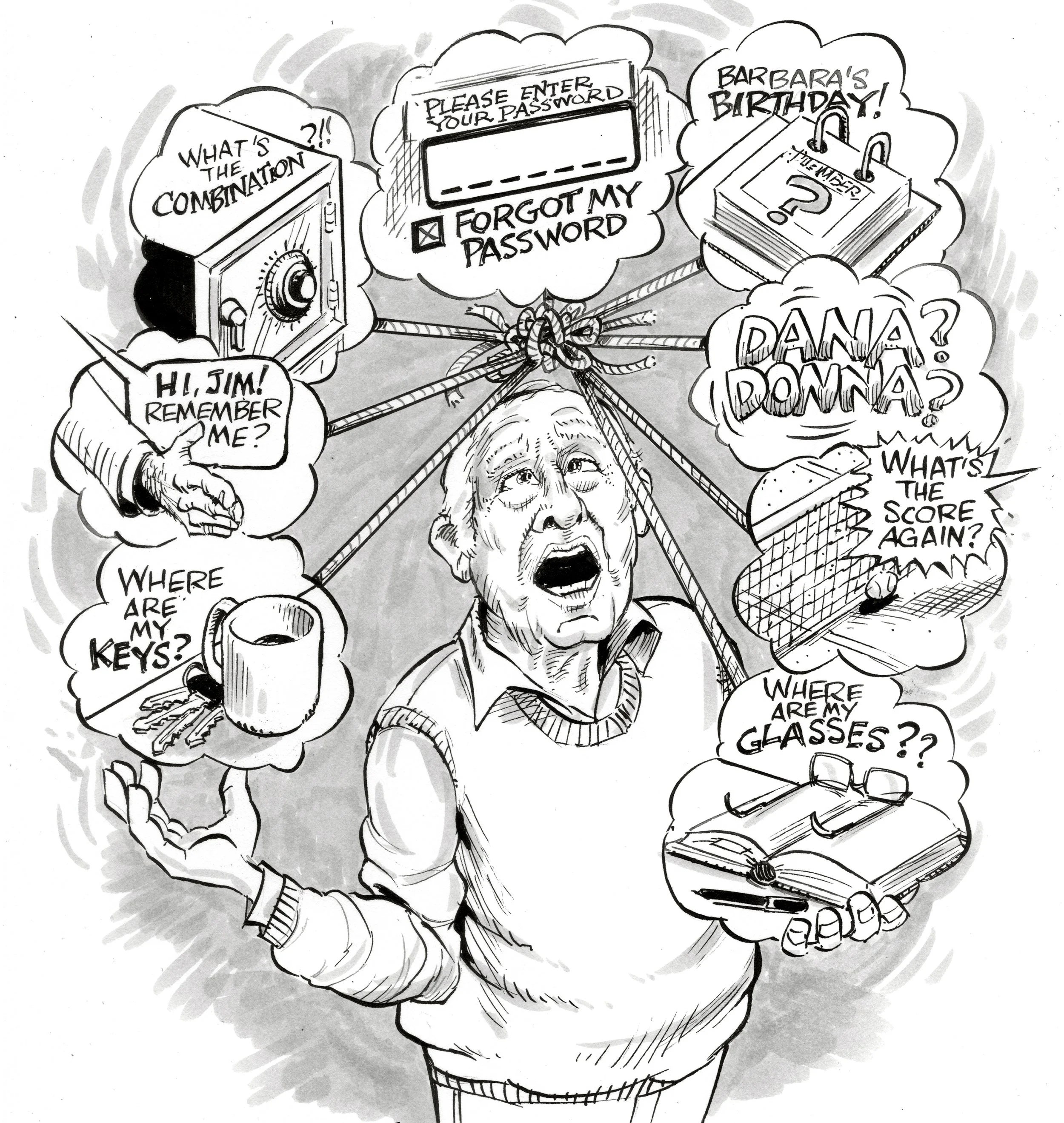
At dinnertime a few weeks ago, my wife and I were rehashing our day.
“How was your lunch with Michael?” Barbara inquired.
“Excellent” I replied.
“What did you have to eat?”
“A nice pasta dish.”
“How about Michael – what did he have?”
“Uh . . . . uh . . . .”
* * *
I’ll come back to this painful scene a little later, but first let me put it into context.
Although I’m using a cane and frequently require a short nap after lunch, I’m handling most facets of being 91 pretty well. But there is one aspect that often drives me up the wall, and that’s not being able to recall specific stuff like names of people and places and other things. And although everyone reassures me that all us oldsters share the problem, I can’t seem to shrug this off. It bugs me, it gets me fired up and angry, and it undercuts a lot of stuff I’m doing that should give me some pride at this age.
This is a subject that I wrote a lot about during my 70’s and 80’s – including a lengthy analytical article titled “Senior Moments,” and an essay in my second blog entry (February 2021) called “Do It Now” on how to help your short-term memory with some weird methods.
I won’t rehash all that here, or speculate on how serious this condition is. (I’m convinced it ain’t Alzheimers, but maybe it’s “Someheimers,” as a friend recently dubbed it.) Nor do I want to examine in depth the various techniques being peddled to us for remembering in advance things that are likely to come up. Most of what I’d like to do here is reveal a few of the feeble ways I’ve been trying (often unsuccessfully) to cope with this situation when it does arise, and hopefully stir my readers into feeding me some other worthwhile methods that they use in similar situations. (Plus I’ve thrown in a few pertinent anecdotes, jokes and a dash of poetry.)
* * *
But now let’s return to me and my wife at dinner that night . . . .
“Uh . . . .” I confessed after a while, “I just can’t remember the name of Michael’s dish for lunch.”
This kicked off a many-minute dismaying conversation in which I was trying to describe Michael’s meal and see if Barbara could came up with the name. My descriptions evidently weren’t that great, and she couldn’t grasp it. Then I started to get mad at her for not taking me off the hook (as she often does), and I found myself exclaiming “You order this dish all the time when we eat out,” but it didn’t help.
I checked some take-out menus in our kitchen, but there was no sign of the dish. Having paid for the lunch, I thought a copy of the meal tab I signed might provide a clue, but I couldn’t find the copy. And so on.
Finally Barbara tired of it all and penned a text to Michael asking him what he had for lunch. He quickly replied, “Calve’s Liver”, and my blood pressure went back down to its normal (slightly elevated) level.
* * *
Let me now describe some of the better ways I’ve tried (not always successfully) to deal with this problem, plus some other stuff.
1. Make a Joke of it.
For some unexplainable reason, when Barbara and I go out to a restaurant with other couples and I’m ordering an alcoholic beverage, I can never remember the name of my favorite cocktail or my favorite red wine. I don’t shrink from this. “Hey, Barbara,” I say loudly for all to hear, “What’s the name of my favorite cocktail (or red wine)”, which she quickly supplies. I laugh it off as I’m ordering – trying not to appear embarrassed in front of the other couples by the fact that I should obviously be able to remember such important names (“Mohito” and “Malbec”). By the way, when I read this paragraph to Barbara, she suggested it would even be better for me just to say out loud, so all could hear, “Hey Barbara, order me a cocktail,” or “Hey, Barbara, I need a glass of wine” . . . . since she’ll then know what to do, and my memory gap isn’t on display.
2. Play Charades
If I’m with sympathetic other folk when this kind of thing happens, and the missing verbiage is an object or at least has a visible shape, I sometimes confess my lapse and get them to join me in a version of the game “Charades” – with me providing visual hints as to what I had in mind, and them trying to guess what it was (for which, upon success, they receive a rousing round of honors).
3. Be Imperturbable
I haven’t mastered this one yet (and perhaps never will), but I do admire the imperturbability others display. For instance, check out Oxford’s Dr. Spooner as he invites a faculty member to a tea party “to welcome our new Mathematics Fellow.” When the man replies, “But sir, I am your new Mathematics Fellow,” Spooner responds, “Never mind, come all the same.”
Even better was what occurred the night famed actor John Gielgud was dining in a restaurant with a well-known playwright. When he spotted a new arrival across the room, Gielgud remarked to his companion, “That man is the biggest bore in London, second only to Edward Knoblock.” At that point, Gielgud suddenly realized that his dining companion was none other than Edward Knoblock! . . . Realizing he’d made a terrible mistake, an unfazed Gielgud quickly added, “Not you, of course. I mean the other Edward Knoblock . . . .”
4. Use a Thesaurus
When I’m writing an essay or fictional piece and can’t come up with a certain word or phrase that I’m sure will convey exactly what I’m aiming at, I don’t screw around with some agonizing search of my faulty memory. Instead I reach for my handy thesaurus to handle the situation – and almost invariably, it hits the spot.
5. Stall
If the lapse occurs when I’m on the phone with someone, I fake a distraction (such as another call coming in, or an intruder barging into my room), and ask the listener to hang on for a minute – thereby buying some time to “locate” the word. If I’m unsuccessful, I resume the call when I can’t stall any longer – but immediately switch the conversation to another subject.
6. A Few Jokes
I like to tell a joke, but only when it has some bearing on the subject being discussed.
Lately, I find a number of the jokes deal with loss of memory, like this one:
Ralph: “I’ve been thinking a lot about “hereafter” recently.”
Jim: “I didn’t realize you were that spiritual a guy . . . .’
Ralph: “It’s not that so much – it’s more like when I go from one room in the apartment to another, and then say to myself, ‘What am I here after?”
Or this one:
An old man is sitting on a park bench, crying copiously.
“What’s wrong?” asks a passerby.
The old man replies: “I have a 25-year-old wife at home who gets up early and makes a great breakfast every morning. She cleans the house, we watch sports together on TV, and after cooking a gourmet dinner, she makes love to me until past midnight.”
“So why in the world are you crying?”
“Because I can’t remember where I live.”
Some of the jokes I like end with a punchline that depends upon a certain word or phrase. Here’s a well known example.
My wife and I are dining at another couple’s house. After dinner, the wives repair to the kitchen, with the guys still at the table – and I’m complaining to my buddy about my failing memory.
“Oh,” he says, “I had the same problem, but my wife got me a great book that explains how to deal with it – by making image associations and such.”
“Great,” I say, “I’d like to read the book – what’s the title?”
My friend’s brow furrows, he thinks for a moment and then says, “What’s the name of the flower you give to someone for a special occasion?”
I don’t answer right away, so he continues, “You know, the one that’s red and has thorns on the stem.”
“Do you mean a rose?” I offer.
“That’s it!” he says. Then, turning toward the kitchen, he yells, “Hey, Rose, what’s the name of that memory book you gave me?”
But here’s the point for this article. That joke should get a good laugh, but the response would be muted if the word “Rose” weren’t readily available to you. So before telling the joke, make sure it is – and if it isn’t, don’t tell the joke.
7. Should you depend totally on memory to recite a favorite poem to your friends?
FUGHETABOUTIT!!
8. Part of the Whole
Let’s say you can remember part of a phrase you want to use but not the whole thing. For instance, you want to tell someone about the wonderful Chilean Sea Bass you had for dinner last night, but the only part of the name you can recall is the origin of the water the fish once swam in. So you say, “I loved that famous Chilean fish....,” letting your voice drop, and allowing your listener to have the honor of supplying the “sea bass” balance.
9. Shifting the Onus
If you want to mention to your knowledgeable friend the name of a certain player on last year’s World Series winner but can’t recall it, you can say, “I bet you can’t remember the name of that great third-baseman on the Dodgers” – hoping against hope that he will remember it and take you off the hook. All you need to say when he correctly reveals the name, is, “Right”, as if you knew it all along. If he flunks the test, act surprised at the decline of his memory and tell him to go look it up.
10. “Something to the effect of . . . .”
When trying to quote a good phrase that someone else used, don’t even pretend to quote the exact words – simply say, “So-and-so had an interesting observation on this point – something to the effect that . . . .”
11. Approximation
When you’re quoting something previously said by the wife of your good friend Carl, but you realize you can’t remember her name, just say “Here’s the way Carl’s wife put it.” If you can’t remember the name of that splendid town you visited on the Adriatic Coast, just pass along the credit to the whole damn coast. And if you don’t recall the names of the terrific vocalist whose voice you’re listening to with a buddy on the car radio, just mumble some favorable words about the performance. Do not say, “What a voice!” as it might tempt your buddy to ask you whose it is.
12. Remember Me?
Don’t panic when you run into someone who asks you, “Remember me?” and you have no idea who he or she is. Instead stick to a ready reply for use in all such cases, such as these:
When someone would ask journalist Charles Michelson, “Do you remember me?” he would answer, “Yes, and it turned out you were right, didn’t it?”
And when someone asked Winston Churchill, “Remember me?” his usual reply was, “Why should I?”
13. Bypass the lyric
I play the piano – mostly popular songs from the Great American Songbook – and sometimes I sing the words along with the melody. At times, I have an audience, and if that’s the case, what should I do when I’m singing along, and I suddenly realize that there’s a word or phrase coming up in the next line of the lyrics that I can’t recall?
The key here is not to be singing the lyrics at that point. It may, however, be a little off-putting to warble the words right up to the forgotten syllables and then suddenly switch off the voice. So when you’re tinkling the keys and this situation comes up, try to anticipate it a line or so in advance. Then just shut your mouth, making sure to play a few extra loud bass notes as you head into the unforgiving territory.
14. A Few Geographic Problems
Some situations are worse than just forgetting a word or two. For instance:
Coming home one night, German philosopher Gotthold Ephraim Lessing realized he’d forgotten his house key. He knocked at his door, but the servant – peering out the window but not recognizing Lessing in the dark – called out, “The professor is not at home.” Lessing replied, “Oh very well. No matter”— and, as he turned to walk away, said, “Tell him I’ll call another time.”
Columbia philosopher Irwin Edman visited the home of a colleague. At 2 a.m. the colleague began to yawn, but Edman didn’t take the hint. “Irwin,” said the colleague finally, “I hate to put you out, but I have a nine a.m. class tomorrow morning.” Irwin replied, “Good Lord! I thought you were in my house!”
15. Do it Now!
I can’t resist including here a tidbit from my blog article on “Do It Now”.
If my brain receives a notice to take some worthwhile action that’s extraneous to what I’m involved in but contains a time limit for accomplishment, I stop whatever I’m in the middle of and do that extraneous deed (or arrange for its timely recall in some fashion that doesn’t depend on trusting my memory).
Here’s a little strategem I’ve been known to try, though with decidedly mixed results. During my entire adult life I’ve worn a ring on my right pinky. I have over a dozen such rings, which are removable, and I alternate them every month or so. (These are to be distinguished from the three-band wedding ring I wear continuously on the fourth finger of my left hand – a wedding gift my wife had fabricated for me in a size too small in circumference to get over the knuckle and thus has never been removed.)
In order to recall something I need to remember, I’ve tried switching the right pinky ring to my left pinky, where it feels entirely unnatural. There’s no ignoring the difference – I’m aware of it constantly – and so any message I want to convey to myself by this unnatural act is poised for successful transmission. But the difficulty here is to remember what message it was I wanted to send. And even if I can remember that the purpose was to remind me to make a certain phone call (as is likely to be the case), the question is, to whom?
I had a good buddy some years back (now deceased) whose first name was Wright but who everyone called by his nickname, “Lefty”. He would have been a perfect candidate for this gambit – of course, switching the ring from right to left pinky could only mean I wanted to call my buddy Lefty. But sadly, Lefty is no longer reachable, and I don’t seem to know any other Lefty’s now....
Well, the gambit can still be useful – it just takes a little more imagination . . . .
16. True Confessions
Well, I have to confess that if, for instance, I’ve temporarily forgotten the name of one of the three Baltic countries, I do pose that question on my cellphone to SIRI. And if Alexa is playing a Willie Nelson number that features a neat harmonica solo by the guy whose name often slips my mind, I’ve been known to ask her who it was before the song ends. And I’m aware of other such aids provided by ChatGPT and Google and others . . . . But I do prefer dealing with these helpful crutches in private than under watchful eyes . . . .
17. The Noun Nemesis
Almost a decade ago, I wrote a meandering poem, “The Noun Nemesis,” that cast the blame for most of these “senior moments” on the difficulty of remembering nouns. Here are some of my favorite lines from the poem. It’s all about —
The way you feel so damn absurd,
when you forget a chosen word.
You’re vexed at the lack of text,
irate at your empty plate,
dismayed by the dumb blockade.
And later on, looking back,
it really stank
to draw a blank.
Well, here’s my most recent analysis
of this distressing paralysis,
When a verbal abyss casts you amiss
(so you feel like a clown,
face wreathed in a frown)
the word that’s escaped you is usually a NOUN!
Just reflect on this:
“promiscuity,” “fortitude,”
“undertow,” “sanitorium” –
all the missing words of renown are a noun.
And part of what a noun embraces –
which your tired brain misplaces –
are names of people and of places.
Henderson, Anderson, Donaldson, Schwartz;
Yokohama, LeHavre, Moresby, and more ports.
It’s a terrible shame
that in recalling such names
I am now forced to claim
that I’m really quite lame.
But hey, just in case you forgot,
there exists a correlative bright spot.
To wit:
Each other form of speech conceivable
is much more readily retrievable.
So, e.g., with an adverb I’m superb.
I can wax astutely on, say, “absolutely,”
and need not be cautionary using a “very.”
(Some folks claim recall of every adverb,
even when they’ve smoked some herb. . . .)
Let’s face it, an adverb never perturbs.
With “and,” “or,” or another conjunction,
you won’t run into any injunction.
We can all function with a conjunction.
Also, with “the” or a similar article,
you’re unlikely to drop a particle.
But as for remembering a troublesome noun,
on a scale of white to black,
I barely register a brown.
On the other hand, my narratives
can be chock full of adjectives.
“Beautiful,” “pretty,” “ravishing,” “cute” –
you always can take an alternative route,
and come up with a viable substitute –
Whereas with nouns,
we have precious few hand-me-downs.
With a participle, I’m no cripple.
I can run errands with gerunds,
and encounter no curbs with verbs.
As for using a preposition,
I’m a veritable magician –
my renditions oft gain recognition –
But I’m not aces
with nouns, names and places.
18. Balance the agony
When I’ve gone through the agony of searching for (and not finding) the right word, I often ease the disgust I feel toward my incapacity by recalling how I can still remember my first phone number as a young lad in knickers (Academy 2-0863) – thereby providing indisputable proof to myself that I’m not entirely demented.