THE CHRISTMAS TRUCE
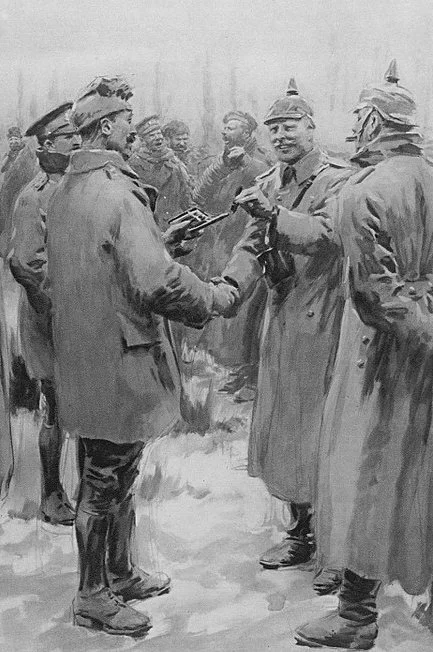
Most of us with an interest in history have heard tales of the December 1914 “Christmas Truce” that occurred between the Germans and the British along the Western Front in the first year of World War I. It strikes me as worthwhile today, 111 years and a bunch of wars later, to take a closer look at what actually went on back then. *
Since the war began in August 1914, fierce fighting had erupted between the Germans and the French-British alliance. By November the armies had built continuous lines of trenches in France running from the North Sea to the Swiss frontier. The war had already claimed hundred of thousands of killed, wounded and missing.
Newly elected Pope Benedict appealed to the parties for a ceasefire to occur at Christmas, but it was rebuffed by both sides as “impossible. As one periodical put it: “The stench of battle should rise above the churches where they preach good-will to men. A few carols, a little incense and some tinsel will heal no wounds.”
Even so, some neutral interaction had been occurring between the belligerants in their respective trenches, particularly between the German and the British – not so much the French. In some areas, for instance, there was a half-hourly truce each evening to recover dead soldiers for burial. The proximity of the trench lines made it easy for soldiers to shout greetings to each other; and since many German soldiers had previously lived in England, they were familiar with its language, its football leagues – even its music. As a result, the events of Christmas weren’t entirely spontaneous.
As Christmas day neared, roughly 100,000 British and German troops became involved in an informal cessation of hostility along the Western Front. The Germans placed candles on their trenches and on Christmas trees, confirming the celebration by singing Christmas carols. The British responded by singing carols of their own.
And then excursions across No Man’s Land began. Small gifts, such as food, tobacco, alcohol and souvenirs were exchanged. The artillery in the region fell silent, and the two sides began jointly singing “Auld Lang Syne”.
Here’s how the scene was described by one British officer (whose death in action occurred less than a week later):
“We are having the most extraordinary Christmas Day imaginable. A sort of unarranged and quite unauthorized but perfectly understood and scrupulously observed truce exists between us and our friends in front. The funny thing is it only seems to exist in this part of the battle line – on our right and left we can all hear them firing away as cheerfully as ever.
“The thing started last night – a bitter cold night, with white frost – soon after dusk when the Germans started shouting 'Merry Christmas, Englishmen' to us. Of course our fellows shouted back and presently large numbers of both sides had left their trenches, unarmed, and met in the debatable, shot-riddled, no man's land between the lines.
“Here the agreement – all on their own – came to be made that we should not fire at each other until after midnight tonight. The men were all fraternizing in the middle (we naturally did not allow them too close to our line) and swapped cigarettes and lies in the utmost good fellowship. Not a shot was fired all night.”
By the way, it wasn’t exactly comfortable in that trench-to-trench landscape of fortified ditches, which one German described as, “Lice, rats, barbed wire, fleas, shells, bombs, underground caves, corpses, blood, liquor, mice, cats, artillery, filth, bullets, mortars, fire, steel: that’s what war is. It is the work of the devil.”
Not everyone was in favor of the truce. Some British officers issued orders forbidding fraternization with the opposing German troops, one of them saying: “It discourages initiative in commanders, and destroys the offensive spirit in all ranks . . . . Friendly intercourse with the enemy, unofficial armistices and the exchange of tobacco and other comforts, however tempting and occasionally amusing they can be, are absolutely prohibited.”
The French didn’t like it either, Charles de Gaulle writing of the “lamentable” desire of French infantrymen to leave the enemy in peace. There is also an account of a German corporal who scolded his fellow soldiers during the Christmas Truce. Such a thing should not happen in wartime, he said; have you no German sense of honor left? That 25-year old soldier’s name was Adolf Hitler.
So it’s a common misconception that the War momentarily stopped on the entire front on Christmas Day 1914. Official casualty statistics for the period confirm that on that day almost 100 British soldiers lost their lives, with 62 more dying over the next 24 hours. Although this was significantly lower than the normal average, it’s ample evidence that the truce was not observed in all sections.
But I want to focus on where it did happen. As the author of “Silent Night” put it, “The truce bubbled up from the ranks. Though it was to become so widespread as to impact much of the front, no one was ever certain where and how it had begun.”
Almost always it was the Germans who at least indirectly invited the truce. They were winning, had much less to lose by it, and Christmas may also have meant more to them. The Germans were weary of a war they were assured would be short; but as they celebrated vigorously and without apparent concern, the British also gave in to their own war weariness.
Here’s how one British soldier described what was happening:
“We ate their Sauerkraut, and they [ate] our chocolates, cakes, etc. We had killed a pig just behind our lines. There were quite a lot of creatures rambling about the lines, including an old sow with a litter and lots of cattle and poultry. We cooked the pig in No Man’s Land, sharing it with the Boche.”
Another wrote:
“I went myself on Christmas Day and exchanged some cigarettes for cigars. The German I met had been a waiter in London, and could use our language a little. He says they do not want to fight. Fancy a German shaking your flapper as though he was trying to smash your fingers, and then a few days later trying to plug you!”
One of my favorite exchanges came between a Brit and a Bavarian:
“They exchanged cards, and promised to meet after the war in both London and Munich, close to where there was some ‘pretty good shooting.’ Parting halfway between the lines with firm handshakes, they exchanged wishes for a good New Year. ‘Oh, by the by,’ said the Bavarian as he turned back, ‘On Thursday’ – New Year’s Eve – we are relieved by the Prussians. Give ‘em hell; we hate them!”
A vivid picture has been painted that during the truce one or more football matches were played between the opposing armies in no man’s land. There are many individual accounts of at least some evidence of a ball making an appearance. But the validity of these accounts has been disputed by some historians, who concluded that attempts to play organized German-British matches failed owing to the state of the ground; and the contemporary reports were either hearsay or refer to kickabouts with made-up footballs such as a bully-beef tin.
By far the most plentiful evidence relating to football being played on Christmas Day 1914 alludes to kickabouts featuring all-British participants. An unnamed British officer wrote of an ‘inter-platoon game of football’ in which a ‘cap-comforter stuffed with straw did for the ball’. Another said, “On Christmas Day we were out of the trenches along with the Germans, some of whom had a song and dance while two of our platoons had a game of football.”
Despite the plethora of official and personal contemporary documentation that exists relating to the Christmas Truce, there is no definitive evidence to substantiate claims that an organised game of football, with scores recorded, ever took place between British and German troops. While it seems clear football did feature in some loose form or another during the Christmas Truce, its importance has become vastly overstated, with modern sentimentality helping to perpetuate the myth.
Unfortunately, this distracts attention away from the remarkable events that we know did occur on that day in December 1914. As one British soldier put it. “We had a great day with our enemies, and [we] parted with much handshaking and mutual goodwill.” Another reported that a German who had lived in London parted from him with “Today we have peace. Tomorrow you fight for your country; I fight for mine. Good luck.” Across the trenches, the Germans sang “God Save the King,” and from their trenches the Tommies offered three cheers.
Even a token return to hostilities was usually preceded by a courteous signal to the other side. A British captain had three shots fired high and harmlessly at 8:30 a.m., posted a sign reading “MERRY CHRISTMAS” above a forward trench, and climbed atop his parapet. The Germans opposite quickly displayed a “THANK YOU” sheet, and their company commander stood proudly on his own parapet. The two officers bowed, saluted, then descended into their trenches, from which the German captain fired two shots in the air. The war recommenced.
Five months into the war, the trenches remained graves for the living. On both sides in 1915 there would be more dead on any single day than yards gained in the entire year. And there would be nearly four more years of attrition – not to determine who was right, but who was left.
There were some minor subsequent attempts at truces in WWI, but not much. In December 1915, the Allied commanders issued orders to forestall any repeat of the previous Christmas truce. Units were encouraged to mount raids and harass the opposing line, while communicating with the enemy was discouraged by artillery barrages along the front line throughout the day. On the German side, a general order was issued after Christmas 1914 that forbade fraternization with the enemy, warning German troops that "every approach to the enemy . . . will be punished as treason."
Although the popular tendency has been to see the December 1914 Christmas Truce as a unique romantic occasion rather than one with political significance, it has also been interpreted as part of the widespread spirit of non-cooperation with the war. Complicated local truces and agreements not to fire at each other were negotiated by men along the front throughout the war. These often began with agreements not to attack each other at tea, meal or washing times. Other accounts describe vivid scenes of men helping enemy soldiers collect their dead, of which there was plenty. One German infantryman described how a British soldier set up a makeshift barbershop, charging Germans a few cigarettes each for a haircut. In some places, tacit agreements became so common that sections of the front would see few casualties for extended periods of time.
The December 1914 Christmas Truce can therefore be seen as not unique but as the most dramatic example of the spirit of non-cooperation with the war that included refusals to fight, unofficial truces, mutinies, strikes and peace protests.
As for the actual Truce, I’ll leave it the way how one Brit participant described the scene: “Looking back on it all, I wouldn't have missed that unique and weird Christmas Day for anything.”
* * *
How about World War II – were there any replicas of the 1914 Truce for American troops? Not really – there were few chances for such events, as American troops were in close contact with German forces only in relatively small numbers in North Africa and Italy prior to the 1944 D-Day landings. And any large scale truce for Christmas 1944 was impossible, since nine days before the Germans had launched the Battle of the Bulge and heavy fighting dominated the holiday.
There is, however, a personal account of a much smaller truce during the height of fighting in the Battle of the Bulge* , and I’ll close with this.
A German mother and child had a small cottage in the Huertgen forest. On Christmas Eve, 1944, there was a knock at the door — three American soldiers, one badly wounded, were standing outside. The mother invited the Americans inside and attempted to make them comfortable.
The men, having lost their battalion, had wandered in the forest for three days, looking for Americans and hiding from Germans. The mother made a meal of potatoes and a rooster that she had saved for when her husband would ultimately arrive.
As she cooked, there was a second knock on the door, There stood four soldiers, wearing German uniforms. Her son was paralyzed with fear. He knew the harsh law that sheltering enemy soldiers constituted high treason – they could all be shot!
The corporal leading the German patrol told the mother, “We have lost our regiment and would like to wait for daylight…can we rest here?”
“Of course,” the mother replied. “You can also have a fine, warm meal and eat ‘til the pot is empty. But, we have three other guests, whom you may not consider friends. This is Christmas Eve, and there will be no shooting here.”
The corporal demanded, “Who is inside? Amerikaner?”
The mother replied, “Listen. You could be my sons, and so could they in there. A boy with a gunshot wound, fighting for his life, and his two friends, lost like you and just as hungry and exhausted as you are. This one night, this Christmas night, let us forget about killing.”
The Germans stacked their arms by the door; and after a quick conversation in French the startled Americans also turned over their weapons to the mother. The entire mixed group, somewhat tensely, sat down and shared dinner.
Relaxation began to replace suspicion. From his food bag the German corporal drew out a bottle of red wine, and they managed to find a loaf of rye bread. The mother cut that in small pieces to be served with the dinner; half of the wine, however, she put away, ‘for the wounded boy.’ Then she said grace. There were tears in her eyes as she mouthed the old, familiar words. There were tears, too, in the eyes of the battle-weary soldiers – boys again, some from America, some from Germany, all far from home.
After dinner, the mother went to the doorstep and asked them all to join her looking up at the Star of Bethlehem. As one of the soldiers later said, “For all of us, during the moment of silence, looking at the brightest star in the heavens, the war was a distant, almost-forgotten thing.”
The truce held through the morning of Christmas day. The soldiers then shook hands and departed, each headed back to his own army.
———————————————
* My primary research sources for this look back were a book titled “Silent Night” – The Story of the World War I Christmas Truce,” by Stanley Weintraub, and the Wikipedia piece entitled “Christmas Truce”.
* Excerpted from an article titled “Truce in the Forest” appearing in Readers Digest in January 1973.