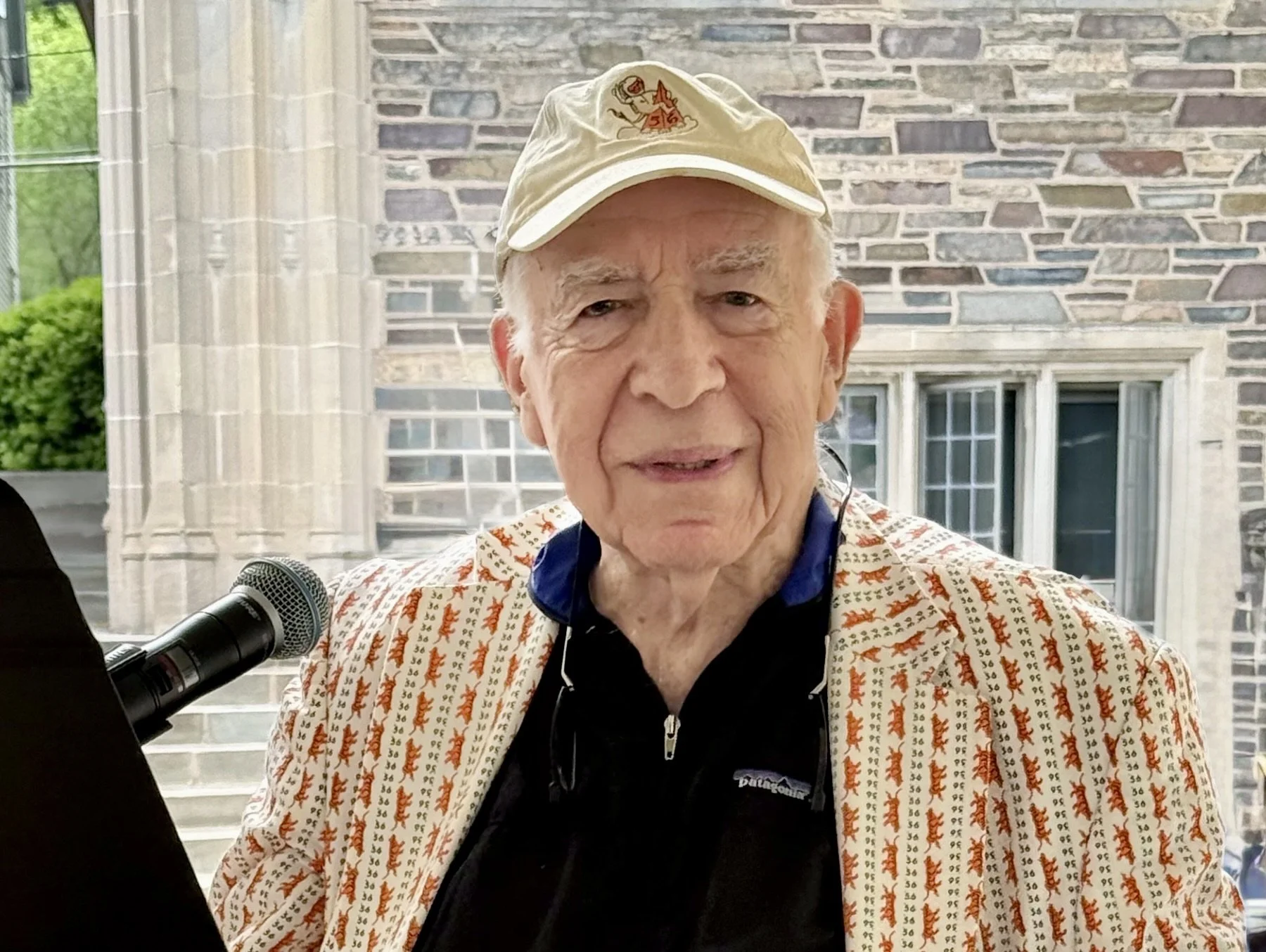
I’m about to turn 92. Let’s pretend you asked me what it feels like. Well, I’d reply, there’s no surprise – 92 is serving up the same dichotomy as in recent years, namely:
There’s a Big Plus – I MADE IT! – A sense of satisfaction at having survived when so many of my contemporaries unfortunately didn’t.
– and –
There’s a Big Minus – PSYCHOLOGICALLY, IT SUCKS! – How did I get to be so old? Where did all those years go?
The minus side this time features a noticeable decrease in physical mobility; a hefty increase in the inability to remember names, places, objects, words etc.; and a greater susceptibility to losing my cool over a variety of personal ineptitudes in dealing with computers, iPhones and such.
On the plus side, there haven’t been any new breakthroughs, but I’m comforted at still being able to function in passable fashion doing stuff I’ve long enjoyed – writing essays and fiction (plus recording vocal versions), playing the piano, and taking photos.
Let me remain positive for a bit. I’ve been able to continue the practice of making monthly entries to my blog for 66 straight months now, each entry containing those three components (writing, music, photos). I’ve also kept up my practice for the last 25 years or so of mailing out around 500 year-end packages, each usually containing a new novella or short story, a fresh musical CD album, and a portfolio of photos. I consider this a worthwhile substitute for my no longer having an active professional life.
I don’t pretend to know how other nonagenarians deal with the problems this decade poses, but for what it’s worth, here is my current recipe.
The toughest time of day for me is when I wake up. My body is wobbly, my brain under wraps. I need a quick shape-up routine to handle the rest of the day on more favorable terms. (By the way, if any of you oldsters out there have developed such a system, I’d be most interested in your technique.)
Mine is simplistic. I mount a stationary bike and pedal at a slow speed, just to make sure my legs will function sufficiently to carry my weight. I don earbuds and listen through my cellphone to some piano tunes that I’ve recorded, providing myself with some pleasurable past moments to push me along. And then, while still on the bike, I’m ready for my daily ritual.
Here it is. I play two games on my cellphone. One is a logic puzzle, “Star Battle Go”, that I’ve set at a level where I can solve it on roughly half my efforts. The second is a word game, “Waffle,” that offers me a similar chance of success.
On most days after a few failures, I’m able to get over these hurdles and feel mildly exhilarated contemplating my success. Now I’m ready to face the day – somewhat assured that my lapses of memory and other such annoyances haven’t frozen my brain irretrievably.
Having solved the puzzles (or even on days when I can’t), I get off my bike and stumble into the kitchen, where my wife Barbara has fixed up a potent energy smoothie for me that brings a smile to my face. Then I read the newspaper, get angry at what’s going on in the world (or giddy when the Knicks win), and settle down at being alive with alternative feelings of pain and pleasure, which I’ll have to make do with until tomorrow.
My original intention for this essay was to illustrate the equal good-bad aspects of life at 92 by offering vivid examples of each. As usual, I often bounce choices like this off my wife, to get her views on the subject.
“How’s that sound?” I asked Barbara. “It sounds terrible!” she replied in a tone of voice that I’ve learned requires me to pay attention.
“How so?” I inquired. Her reply was firm and immediate. “Because no one will be interested in your troubles – they’ve got enough of their own. Just stick to the good stuff.”
One reason that our marriage has proved so successful – which was definitely one of the “good things” I intended to emphasize in my treatment of divided reactions – is that I’ve learned how to say “Yes, ma’am” when Barbara Fox hits me with this kind of observation. So I shall follow the safe path and just let you know what I’ve encountered that’s at least relatively positive.
I decided to test out this approach by starting with one of the major downers of the 90-plus decade – the spectre of death. No coffins or eulogies here, though – just the observations of five individuals who have looked the future squarely in the eye and managed to avoid despair.
– Author W. Somerset Maugham, who simply ignored the reality:
Dying is a very dull, dreary affair. And my advice to you is to have nothing whatever to do with it.
– Actor Edward G. Robinson, who focused on a positive aspect amid the gloom:
If He has given us one marvelous gift, it is that He does not permit us to know the future. It would be unbearable.
– This dialogue, quoted by Ram Dass, that backs up Robinson’s point:
Zen Student: “What happens after death?”
Zen Master: “I do not know.”
Zen Student: “How can that be. You are a Zen Master!”
Zen Master: “But I am not a dead Zen Master.”
– Musician Artur Rubinstein, who handled it this way:
I live by one principle. Enjoy life with no conditions . . . . [U]nderstand that life is a wonderful thing and . . . enjoy it, every day, to the full.
– And author Agatha Christie, who acknowledges some pain but emerges intact.
I like living. I have sometimes been wildly, despairingly, actively miserable, racked with sorrow, but through it all, I still know quite certainly that just to be alive is a grand thing.
* * *
Well, that’s enough about death. (I bet Barbara will enjoy my one-sided treatment). Now let’s turn to the subject of health, I’ve had some minor health problems over the years but they don’t compare in seriousness to the ailments that many of my contemporaries have to contend with. However, I think a few words are in order about my relatively recent use of a cane . . . .
“Hey, Freund,” interrupted Barbara – “I told you not to focus on negatives . . . .”
“Yes, yes,” I replied to her, “But the fact is I’ve developed a real affection for the cane’s help in preventing falls and its ability to motivate pedestrians and motorists (but unfortunately, few bicyclists) to extend me certain courtesies.”
“Okay,” she said in a voice that lacked enthusiasm – “but just give them that one sentence and then move on to another subject.”
Now I decided to seek her counsel before venturing onto tricky ground. “So, Barbara, how about the subject of hearing aids?”I’m now using them with some regularity when among my family and friends or watching TV shows that originate from Great Britain and lack titles. I had been under the impression that their use pleased my wife by eliminating her need to repeat her latest words.
“Mention it, if you must,” she replied wearily, “but leave out my endorsement.”
“Hey, Fox, what about that daily half-hour nap after lunch that I so treasure – a new habit I should have adopted years ago and which I expect will stick around for the years to come.”
“That’s okay – at least it gives me confidence you won’t sleep through dinner.”
Since we seemed to be getting somewhere, I decided to test how far we’d gotten. “So, how about a brief allusion to the torture I experience, as you have so often witnessed, getting my body out of the back seat of a NYC taxi cab?”
Her voice took on an immediate strident tone. “I thought I told you . . . .”
“Okay, okay, honey, just joking . . . . But there is one negative I would like to spend some time on, which is memory loss –”
She interrupted with a question. “Hey, hubby, what’s my first name?”
I paused, but only briefly. “How about ‘Barbara?’”
“Congrats – you’re okay – now move on to something else.”
Loss of word memory is the negative subject I’ve written most about in recent years. It’s a real problem, but I’m not even going to bother asking Barbara if I can write about it here – I know damn well what she would say. So I’ll just refer you to my long article “Senior Moments” from a few years back, [drop box link] and my article “What to do about The Unremembered Word” in the February 2026 blog entry.
* * *
My mother, who was very positive about most things, refused to treat the 90’s (and beyond, up through 105) as the self-styled “Golden Years”. I’m with her on this – I consider the 90’s at best to be Gold-Plated. Here’s a great example of the dichotomy from Judith Viorst.
My scalp is now showing/ My moles keep on growing/
My waistline and breasts have converged./
My teeth resist brightening,/ I’m in decline,
It’s positively frightening./
A new moon’s arriving, Sinatra is jiving,
My husband is holding my hand./
The white wine is chilling / I’m still alive./
It’s positively thrilling!
Here are three other formulations for us oldsters to muse on:
W. Somerset Maugham’s dictum that:
Old age is ready to undertake tasks that youth shirked because they would take too long.
Lady Nancy Astor’s endorsement of a more balanced approach:
I used to dread getting older because I thought I would not be able to do all the things I wanted to do, but now that I am older, I find that I don’t want to do them.
And Statesman George Clemenceau’s observation (which rings very clear to me):
I am old enough to tell the truth. It is one of the privileges of age.
* * *
Telling the truth – one of the privileges of age – thank you, George C. And the truth here is, I must confess, I’m not comfortable with this equality between the good and bad aspects of life at 92 that I’ve been espousing.
All my life, I’ve tended to be an optimist – a glass-half-full kind of guy; and I really don’t want to trade in that approach just yet. Sure, much about being 92 is troublesome and not easy to overcome – but deep down, I want to remain positive about my present situation. I’m aware that there are moments when I don’t feel that way, but I’ve decided it often comes down to a matter of attitude – or, if you will, of such stuff as disposition, temperament, spirit and outlook.
I’m reasonably certain I still possess the intangible traits I’ve long prided myself on, but I realize the need to get better at putting them to use in my 90’s. I have to keep in mind that no matter how frustrating something may seem, I’m still able to overcome the negativity (or at least neutralize its effects) and preserve my otherwise favorable view of life at 92.
I actually made a start on that task this week. I finally realized that the discomfort and frustration of certain bothersome activities I’ve been dealing with can be minimized when I’m not operating under time pressure to get them done. “Hey, Freund, you dummy,” a voice slipped through to my unconscience, “You can handle troublesome stuff much better when you take things at a slower pace.”
It makes a lot of sense. When I’m pushing myself uncomfortably, I’m trying to emulate what I could do favorably 15 years ago, but which I just can’t equal today – and that’s when things can get tough. By pacing myself more methodically, I can come closer to a comparable favorable result – and that’s just what I’m working on now.
Anyway, that’s my present attitude going forward. In more general terms, I’ll try not to let myself be overcome by stuff that can be adequately handled in a way that preserves the positive benefits of a long life.
Over the past 92 years, I’ve managed to do just about everything I wanted to do. As a result, I don’t have a pressing bucket list of things I wish to accomplish before kicking off.
That doesn’t mean there aren’t things I’d like to do, such as finish a short story I’m currently working on, continue feeding my blog, and sending out year-end packages. But I don’t feel the need to continue to do what I’ve done so far – in other words, that pressure is off.
I consider this a good development. Nothing is driving me to do something that may be beyond my present physical ability (such as climbing the highest peak of all seven continents, although I must admit I never contemplated this even in my most salad years), or mental competence (such as writing the Great American Novel, which was always beyond my aspiration). Sure, there are new places I’d like to see, or favorite locations to return to, but traveling is tough for me nowadays, and I can do without those pleasures.
I guess a case could be made that this self- satisfied view isn’t such a good thing – that maybe there ought to be something new and desirable that I should be anxious to do, at least if it’s within reach. And perhaps such an item will eventually come along. But it’s not currently in view, which makes me content that I have already lived up to whatever I wished for.
For those of you who do not agree with my posture here, you may concur with Judith Viorst, who took aim at today’s ubiquitous epigram in this fashion:
I mobilize the wisdom of a lifetime /
And tell my envious heart, /
“Been there, done that” – /
To which her envious heart replies /
“But I want to be there again / And do that some more.”
* * *
The following thoughts follow very closely what I expressed in my 80, 85, and 90 essays on aging – but at least some things don’t change very much in later life.
As I’m sure most of you would agree, a prime pillar of happiness as we age comes in the form of family, friends and associates. This happens to be an area in which I’ve been most fortunate, so please indulge me while I pay appropriate tribute where it’s due.
Barbara has a wonderful extended family with lots of meaningful relationships. From the outset, the Fox-Hilton clan – Anita and Al, Marjorie and Joe, Alexis and Ali – took me into their inner circle as no mere in- law, but always as one of the gang. In later years, husbands (Josh and Michael) and younger generations (Kate, Charlie and William) got into the act and provided new joy. I stay in regular touch with my cousins, especially Judy, Joni and their offspring, as well as with Pat.
I’m enthusiastic about my warm relations with sons Erik and Tom (and theirs with each other). We share good times, reminisce about joyous moments from the old days, laugh a lot, play music together, vie at backgammon. I’m supportive where I can be helpful, and from time to time they actually seek some counsel from the old guy. Erik, who lives in New Jersey and works there on financial matters for Conair Corporation, has become very attentive to his aging father in recent years, helpful to me in so many ways. Tom lives a lot further away in California, where he has pursued a successful career as a singer-songwriter, but we stay in touch by phone and make up for the distance on the few occasions when we’re able to get together in person. And the three of us conclude most of our frequent phone conversations with a mutual chorus of, “I love you.”
Each son has sired a child – Tom’s Ryan and Erik’s Paige – and the boys (now divorced from their former wives) are exemplary fathers. The kids (now 22 and 19) are bright, warm, and delightful. Ryan graduated with high honors from Johns Hopkins this year; Paige has been at U. Cal (San Diego) the past two years and is transferring to NYU this Fall. My times with them are a real tonic, and I feel their affection toward me is genuine. The sole problem up to now has been geography – that these treats can only be savored on a part-time basis, although I envision better days ahead with Paige in New York. I wish they had lived down the block, where I could have taken more advantage of my good fortune in being a grandfather and perhaps feel like I’m contributing to their maturation – something that’s difficult to do when the time spent together is limited.
But a wife is both a companion for all seasons and a full-time commitment. Barbara Fox and I celebrated our 41th wedding anniversary this past January – and all I can say is that it gets better each year. The woman is a real dynamo – handling major residential transactions, rescuing abandoned dogs while tending her own menagerie, nourishing her family, playing tennis, and so on. But, oh boy, with all that, does she ever take loving and supportive care of her guy. The Fox is so consistent – none of those highs and lows that can bedevil other unions – I always know where she stands. And such fun to be with – we’re laughing together and reminiscing and planning all the time. And in such good shape. . . and I find her so attractive. . . . Negatives? Well, I’m not happy about her predilection for throwing out my old magazines. . . . Anyway, you can bet that Barbara is going to do her best to keep me youthful – she simply won’t allow me to wither away.
I think a word is in order here regarding our dogs. I swear that the subject of canines never came up in my conversations with Barbara prior to marriage, let alone being singled out in our pre- nuptial agreement. But in the past decades, Barbara has fallen in love with the critters. At present we have five dogs, with several sleeping between us on our king-size bed. I’m relegated to a small sliver at one edge, which requires me to sleep on my side since there’s no room for a full body profile.
The practicalities of the matter are that I’ve got to live with this woman (who’s otherwise flawless), so the only thing I’ll say about our animals is that they’re basically a decent bunch. I do my small share of petting and awarding treats, I’ve managed to develop some promising relationships with several of them, and I genuinely mourn their inevitable passing.
As for friends, I feel blessed – they form an indispensable and disparate multitude. Some of the closest date back to high school and college, with the relationship refreshed each year. Others have been more recent additions – a number of them through Barbara’s contacts. They’re a healthy mix of men and women, contemporaries and younger folk, New Yorkers and geographic outliers. When we get together, we pick up right where we left off months ago. I make a real effort to reach my friends through my blog and the annual year-end package I send out, and I’m hopeful that this helps to keep the relationships alive.
I also wish to acknowledge the assistance I receive from a variety of people. At the forefront is my invaluable assistant Raymond, without whose many talents I would simply be unable to remain productive (and keep my sanity). I’m also grateful to our dog-nanny / house manager Malen and housekeeper Henry, and a host of others.
* * *
Last night, I pushed back from the dinner table and said to my wife: “Well, that was a great meal you cooked, Barbara. And by the way, what do you think – did I stick (mostly) to positives in the essay?”
“Not bad for a guy who sees the glass as half full. . . . Now how about taking out the garbage. . . .”