More Roger’s Rule for Aging
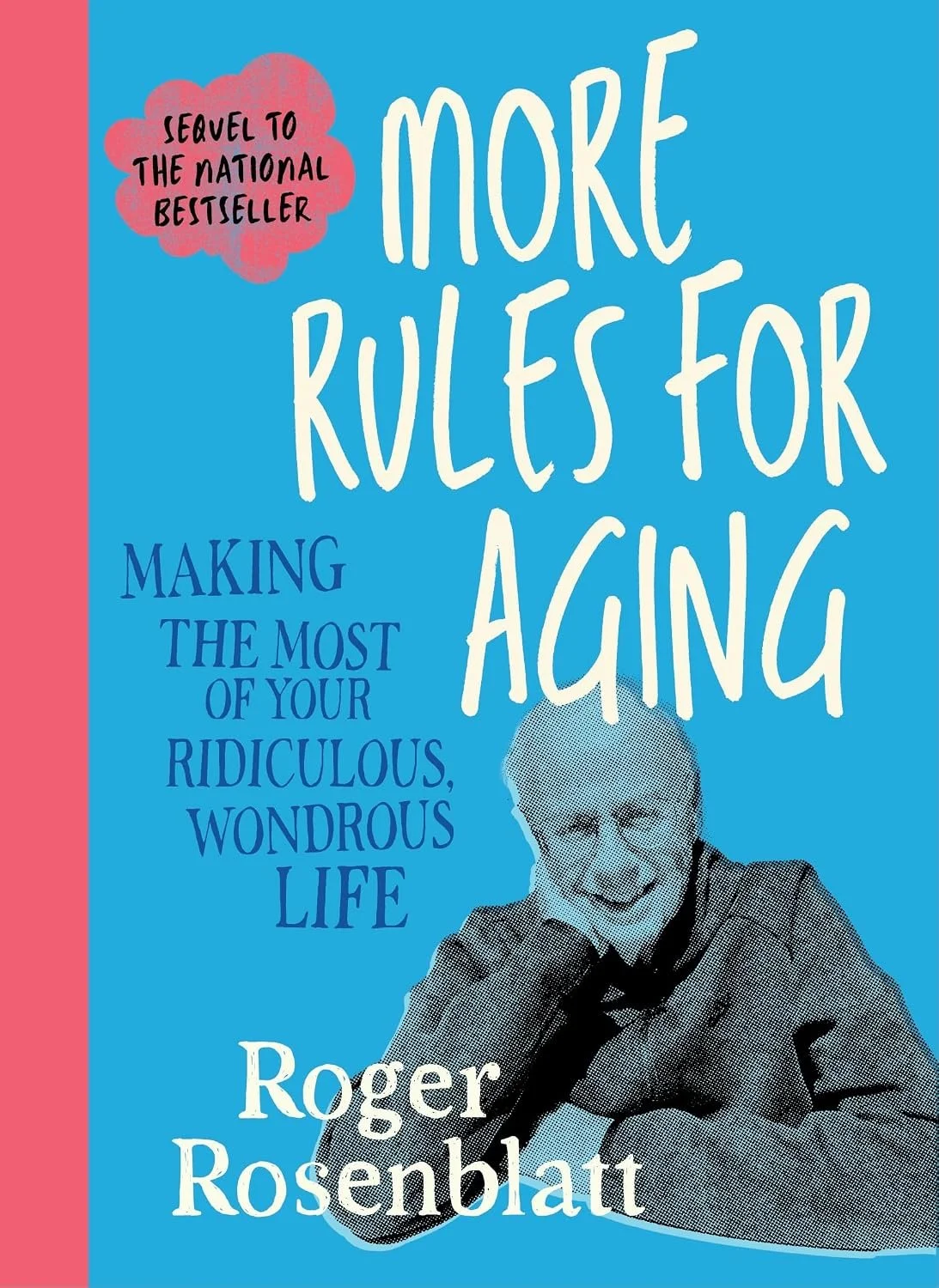
Back in 2022, I entered an essay in my blog titled “An apprehensive glimpse into Roger’s Rules for Aging.” It was my introduction to 58 of Roger Rosenblatt’s offbeat, wry, witty and thought-provoking “rules”.
This year, Roger published a new book called More Rules for Aging, which offers 114 new rules and deserves attention from those of us in the aging crowd. You don’t have to subscribe to all his rules (I don’t), but they’re worth examining, and that’s what I intend to do here with a few of my favorites.
The 114 “More Rules for Aging” are mainly a mixture of do’s and don’ts.
Let’s start with a half-dozen of the don’ts.
1. Don’t.
Roger’s first rule is even titled Don’t, which he applies principally to “impulsive activity”. For instance, you see a beautiful jogger in her 20’s run swiftly by, and you think, “I used to do that . . . . Of course I haven’t tried running for the past ten years . . . . (but) my legs must have the muscle memory. . . .”
“No,” says Roger, “Don’t try it . . . . As soon as you take that first bold step, the next time you see your legs, they’ll be horizontally on a gurney.” His basic point is, “You are not the person you were. Even then you were not the person you thought you were. And now you are older, trudging along the street, happy if you make it to the corner . . . .”
As for me, hobbling along clutching my irreplaceable cane, I can personally swear by this one.
2. Don’t hear the cheers.
This mainly applies “to people in later life, who are often given lifetime achievement awards and other recognitions in evidence of how wonderful they are.” According to Roger: “Pay no attention to these accolades. Just proceed to live the life you’re living, giving it whatever it requires . . . . One makes a great mistake believing the grand things said about him or her, even if those things are true. Especially if they’re true.”
Well said, Roger, but I have to confess I wouldn’t mind getting a few of those accolades now that I could then cast nimbly aside . . . .
3. Do not seek immortality
Roger: “It won’t come to you anyway, certainly not through your works and achievements . . . . But the good feeling you have for others, and they for you, that goes on forever.”
I’m now probing my thesaurus to see if there’s some word or phrase a little less pretentious than immortality that would reassure me I won’t be completely forgotten after kicking off.
4. Don’t Flirt.
Here’s Roger’s take on this one: “Though you look every day of your age, from time to time you will persuade yourself that you look younger than springtime . . . . Accordingly, you will make inappropriate comments to the waitress. You look ridiculous behaving this way, but only you are not aware of it.” At which point Roger furnishes us with an apt quote from Ann Landers: “You’re like a dog chasing a car. You wouldn’t know what to do if you caught up with it.”
Okay, okay, I’ll make sure to take this one to heart.
5. Don’t criticize anyone, for anything, ever.
In Roger’s view: “There is no such thing as constructive criticism.” As bad as people can be, “do not say a critical word. No one will improve, everyone will resent you, and they’ll criticize you for opening your mouth.”
This rule didn’t come easy for me, since I used to justify the constructive law-firm-partner criticism I dished out to errant associates as helpful to their performance and the firm’s effectiveness. I’ve become much more circumspect in retirement and appreciate the wisdom of Roger’s approach.
6. Don’t look afraid, especially when you are.
Roger: “Much of the time we’re scared stiff. But to show fear would be a bad mistake, because human beings, like other animals, can detect the weak ones among them . . . . Don’t look arrogant, either. Just compose a face that points to the logical absurdity of threatening someone your age. ‘What are you going to do? Kill me?’.”
I appreciate Roger’s wisdom here, but I wonder about my record of compliance.
* * *
Now here’s a half-dozen of the do’s.
1. Talk to Yourself.
Here’s Roger’s rationale. “It’s supposed to be a sign that you’re going gaga, but I say the more you talk to yourself, the clearer things will be. And you’re very good company. Who else knows as much about you as you – your tastes, your likes and dislikes, what you know and what you don’t. If you have a problem, ask yourself for help.”
This makes sense to me – provided, of course, that you’re satisfied you possess good judgment.
2. Only Look at the Rim.
Roger compares this to when he used to play basketball and concentrated his efforts solely on the basket. “Anything that potentially is in your way – a stupid colleague, a noisy neighbor, an enemy in the office, a bad cold, a broken sidewalk. Disregard it and concentrate on where you are headed.”
I’m with him here as regards colleagues, neighbors and enemies, and I might even go along with a bad cold; but when my cane and I are I’m out for a tenuous stroll, my eyes are consistently searching for broken sidewalks.
3. Go where you are loved . . . .
“. . . and where you love.” Roger: “If you head off for enemy headquarters, “you will be greeted by false praise and false affection . . . while, out of your sight, they plot your assassination.”
This one does seem a little too strong, but it’s headed in the right direction.
4. Make an Enemies List, then Burn it
You’ve undoubtedly acquired a few enemies through your life whom you would like to punish, says Roger. But, he cautions, “Forget it. Thinking of them will also give you agita, especially now, when time is too precise to waste on trash. Instead, make a list of their names, give it the once-over, then burn it. And watch it burn in the fireplace. It won’t give you the satisfaction of seeing the bastards burn in the flesh, but use your imagination.”
Not bad. I have to admit, though, this never occurred to me . . . .
5. Make Young Friends
“For older folks there is nothing more energizing than the company of the young. They’re bright, enthusiastic, informative, brimming with life, and they do not know when you are telling them lies.”
I concur whole-heartedly.
6. Need a wheelchair? Do you ever!
When you’re in a situation that requires you walking long distances and you’re offered the opportunity to get a wheelchair, Roger cautions. “Do not let your erroneous image of yourself as Tarzan or Jane get in the way. Your response should be yes, yes, yes. There is nothing in your experience that compares with the thrill of being rolled through” a big airport.
Absolutely, Roger, I can personally vouch for this one – it’s a ball.
* * *
There are plenty more rules in Roger’s book that are worth examining – for instance, this half-dozen:
Don’t make jokes to those who won’t get them.
Be wary of your conscience – it too can lie.
Start and end every day by listening to Louis Armstrong.
If it takes three adjectives to describe something, you have the wrong something.
Call every young man you’re introduced to, “Pal. You won’t remember their names, and you don’t want to offend them by asking repeatedly.”
On mental blocks, don’t be so intent on getting rid of them. They’re there for a reason.
* * *
I’ll end this survey with three of my favorites from Roger’s present book, plus two other which are contained in both books.
1. “If you’ve had a good strong marriage, filled with all the laughter, thought, generosity, heartbreak, and forgiveness that characterizes good strong marriages, say thank you to your spouse every day. Every day, because you don’t know how many days you have left, but mainly because she or he deserves it. Every day. And twice on Sunday.”
2. “You have a storehouse of song lyrics in your brain. From time to time you quote them, even sing them, to the general bafflement of young people around you. Yet the old songs are the best, are they not, written at a time when artists actually thought they’d make lyrics out of the English language. Ira Gershwin, Cole Porter, Irving Berlin, Richard Rodgers. Nothing can touch them. Nothing can deprive you of them, or of the world they evoke.”
3. “Except for matters of the heart, there’s no such thing as a small compromise. Give in a little, you might as well give up the ship. Many years ago at Harvard, during the McCarthy years, the students were required to sign a loyalty oath to the country and mail it to Washington in order to maintain their scholarships. At a meeting of the faculty, the professors protested. A professor who had come from Italy during the Second World War raised the question to the dean. The dean said that the loyalty oath was merely pro forma, and had no more meaning than licking the stamps on the letter.
The Italian professor rose. “Mr. Dean,” he said in broken English. “I’ma from fascist Italy. And in fascist Italy you learna one thing. First you licka the stamps. Then you licka something else.”
* * *
Nobody is thinking about you
“Yes, I know, you are certain that your friends are becoming your enemies; that your grocer, garbage man, clergyman, sister-in-law, and your dog are all of the opinion that you have put on weight, that you have lost your touch, that you have lost your mind; furthermore, you are convinced that everyone spends two-thirds of every day commenting on your disintegration, denigrating your work, plotting your assassination. I promise you: Nobody is thinking about you. They are thinking about themselves – just like you.”
It doesn’t matter.
“Whatever you think matters – doesn’t. Follow this rule, and it will add decades to your life. It does not matter if you are late, or early; if you are here, or if you are there; if you said it, or did not say it; if you were clever, or if you were stupid; if you are having a bad hair day, or a no hair day; if your boss looks at you cockeyed; if your girlfriend or boyfriend looks at you cockeyed; if you are cockeyed; if you don’t get that promotion, or prize, or house, or if you do. It doesn’t matter.”
WHEW . . . !!!