THE PENULTIMATE EULOGIST
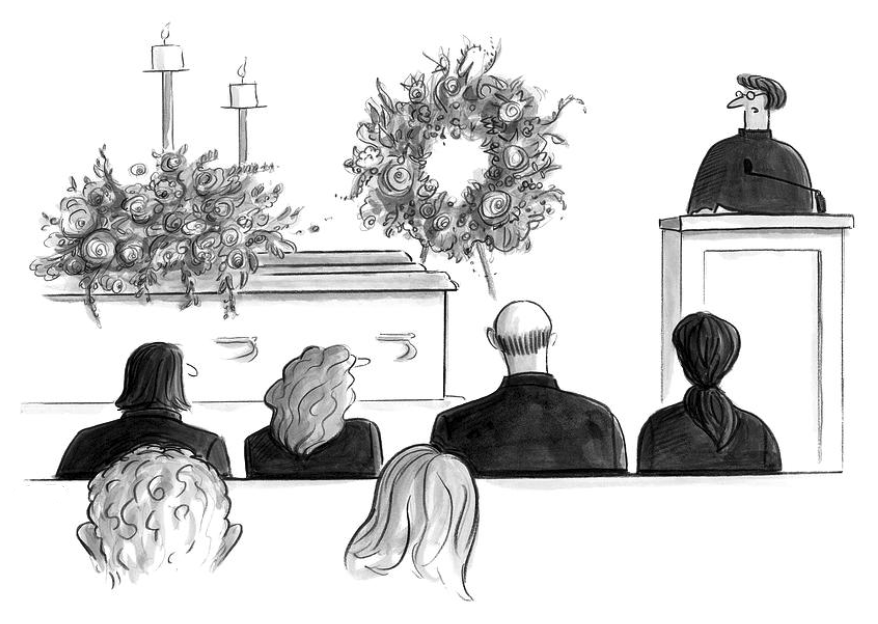
Click on the Play button below to listen to the story, or read the full text below, or you can do both at the same time.
Walt sat at the desk in his home office with pen in hand. The desktop was almost bare, except for a yellow pad on which he had yet to inscribe a single word of wisdom.
He was about to start work on a eulogy he’d been asked to deliver at an upcoming remembrance service. The subject of the eulogy was his longtime good friend Roy, who had died from a heart attack a month ago.
Walt, who recently turned 80, hadn’t been surprised when Roy’s widow Jeanette sought his participation in the service. After all, Walt and Roy had been best buddies since their college days; and Jeanette knew that Walt was qualified for the task, having heard him eulogize several of their mutual friends in recent years.
When Jeanette proposed the task to him, Walt accepted immediately, letting her know he was flattered to have been selected. He then asked her a few questions, including how long the eulogy should be.
“Well,” she replied, “other than you, the speakers are all going to be family members, so there’s no reason for you to feel time-restricted. I just want you to let the audience know that Roy was a quality individual who lived a fruitful life, over and above taking grandkids to the movies.”
This was no problem for Walt, who had always considered Roy to be a terrific guy in all respects – professionally, personality-wise, trustworthiness, and so on. He was sure these aspects of the eulogy wouldn’t be difficult to compose, and began making some general notes on the pad about Roy’s prolific life.
But what intrigued him more in the eulogies he delivered for close friends was his attempt to inject into the text some special stories involving the deceased – tales that were not only interesting but also revealed some favorable aspects of his subject’s character.
Walt knew that this would be quite doable with Roy, since he had plenty of material of this type from their many personal interactions over the years. He had almost instant recall of stories that displayed Roy’s good heart, showed what a loyal friend Roy was, illustrated how insightful Roy could be, and pointed up his substantial physical strength.
Walt decided to get tales illustrating these qualities in place before mapping out the more prosaic sections of the eulogy. He jostled his memory as to incidents he might use, jotted down their particulars, and ranked them to determine which ones were best – eliminating those that weren’t sufficiently specific to make the point he wanted to express, or that contained elements that Roy’s family might find embarrassing in some respect.
He ended up an hour later with four specific episodes that he deemed the most interesting and best supported the key points he wanted to stress. Even though the duration of his eulogy wasn’t limited, he sensed that voicing more than four might turn off some in the audience.
At this point, however an errant thought invaded his process, reminding Walt of a possible complication he felt needed to be dealt with. It stemmed from a book he’d been reading recently by Roger Rosenblatt called “Rules for Aging: A Wry and Witty Guide to Life.”
As Walt reflected on each of the anecdotes he’d decided to include, he noted that he had been involved with Roy in all of them.
Well, he mused, that’s not so surprising. They’re each first-hand observations I’ve made of my buddy in action. In fact, that gives them a lot more authenticity than if I just related things I’d heard about him third-hand.
Still, as he examined each incident featuring Roy, Walt realized that he himself had played an active role in each of them.
No problem – it just heightens the accuracy of my observations regarding the admirable qualities Roy was displaying at the time.
But upon further reflection, Walt became aware of an additional feature in each case. Not only did the scenes all portray Roy positively, but each also cast a favorable light on Walt. And that, Walt realized, is where the rub comes in.
In Rosenblatt’s book, one of his wry “rules” was that “IT’S NOT ABOUT YOU,” which focused “on the habit many folks have fallen into of believing that “all questions are about themselves.” And the prime examples Roger used to make this point came from eulogies delivered upon someone’s passing, to wit:
“Just listen to an author (John) eulogizing from the pulpit about a prominent deceased book editor: “He once said to me, his eyes moist with tears, ‘John, you are the best writer since Hemingway’.” Or a female counterpart: “[The deceased] said, trembling from head to foot with joy, ‘you are the best writer since Virginia Woolf.” Or the man who talked for a half hour about how much the dearly departed had relied on the speaker’s judgment.”
And Walt then recalled Roger’s specific advice on the subject:
“Though you are certain that you are the center of the universe, you might acknowledge, in one or two instances, that you ought to travel to another planet.”
Walt chuckled to himself as he recalled Roger’s examples, knowing he would never get anywhere near those eulogists that Roger satirized. Reflecting on other eulogies he’d delivered, Walt had to admit that he favored personal recollections over generalized plaudits, thus putting himself “in the picture,” so to speak. But he was certain he had never come across to the audience as anything more than an observant companion – in no way the central character.
Still, although he was conscious of not aiming to blow his own horn, he realized that a listener to the four incidents with Roy might conceivably feel that Walt was also touting himself. And so he proceeded to review each of them with this risk in mind.
The first episode was meant to show Roy’s profound sense of personal loyalty. Back then, about five years ago, Walt had just been honored as “Man of the Year” by a public service organization that he and Roy belonged to. Following the hotel luncheon at which the award had been presented, Roy and Walt paid a visit to the hotel bar for a celebratory drink.
A member of the organization, who had clearly been drinking too much, came over to their barstools and proceeded to tell Walt that he never should have won that award – that “he must have bribed the selection committee” – and added a few other nasty charges in a mean manner. It wasn’t pleasant, but Walt was inclined to let it pass without escalating things into a two-way confrontation. Not Roy, though, who was incensed at the drunk’s attitude and proceeded to punch the nuisance square on the chin, which he followed by calling hotel security to “eject this bum from the bar so that we can go on with our celebration.”
In Walt’s mind, Roy was the clear hero of this confrontation, proving his loyalty to Walt in unmistakable terms. But as he reviewed the incident today, Walt found himself wondering whether a listener might focus on Walt having just won that “Man of the Year” award – perhaps even speculate that the main reason Walt was telling this tale was to get that point across. This certainly hadn’t been Walt’s intention, but he had to admit that such an interpretation might not be out of the question . . . .
The second anecdote Walt had chosen was meant to display Roy’s notable humanity. Ten or so years ago, Roy, Walt and their mutual friend Joey (who has since passed away several years back) were walking down an empty city street one night. They came across a raggedly dressed older man lying in the gutter, seemingly dead to the world. Joey, who saw him first, pointed the man out to his companions, then sped up his pace exclaiming, “Let’s get the hell out of here before we become involved.”
Walt had been more concerned about the well-being of the man lying on the curb. He recalled stopping in place and saying something about how they couldn’t just leave him like that; but he had to admit he did nothing tangible to rectify the situation. Roy, however, who had been further away when he heard Walt speak up, didn’t hesitate to act. He turned back, went over to the curb, examined the old man, spoke to him, called for medical help on his cellphone, and ultimately placed him in the care of an EMT unit.
Roy was clearly the central figure of this story – but would it have happened if Walt hadn’t spoken up about not leaving the guy like that, especially after Joey urged them to quit the premises? Oh, shucks, Walt mumbled to himself:
I can just imagine some listener feeling that I told the tale to elevate my sympathy for the guy’s plight, rather than noting my non-action in comparison to Roy’s positive activities to bring the guy real help.
The third incident, designed to display Roy’s insight and judgment, involved a first novel that Walt was writing a few dozen years ago, which he asked Roy to read in draft and offer his comments. Roy did so, and although generally praising the draft, singled out one key segment that he felt needed rewriting. “Your protagonist’s reaction to what is occurring is just too tough,” Roy told Walt – “what he really needs to do is show some tenderness.” He then offered Walt several specific suggestions as to how to accomplish this.
Walt took Roy’s advice and rewrote that section of the novel in accordance with Roy’s insight. The novel was published and enjoyed some reasonable success – with all the reviews singling out the rewritten segment as being the best thing in the book.
Walt winced as he recalled this tale. He could readily see how some listeners might consider that Walt was using the example to remind his audience that the eulogist himself had written a successful novel.
The fourth episode, meant to highlight Roy’s physical strength, focused on a trip the two of them had taken many years back to climb the toughest peak of a substantial mountain. When they got half-way up, Walt’s foot slipped on a tricky precipice, and he dangled on a single rope. Walt had always been sure that the only way he narrowly avoided a dangerous fall was through Roy’s adroit maneuvering and considerable bodily strength.
Hell, there was no question that Roy was definitely the hero in this one, and I’ll hold nothing back in pointing that out. Still, I guess some skeptical listeners might find it presumptuous of me to be advertising myself climbing a steep mountain . . . . I can just hear them thinking, ‘What the hell was Walt doing up there in the first place’. . . .”
At this point, Walt broke off his deliberations and went down to the kitchen to eat the tuna sandwich his wife had prepared for his lunch. But as he sipped his cranberry juice, he just couldn’t stop thinking about the eulogy and the situation he found himself in.
Walt was unwilling to let these concerns cause him to eliminate using those four good stories as specific indications of his friend’s best traits. Having decided this, he could see there were three basic ways to deal with the problem.
First, tell the stories just as they occurred, and don’t worry about some jerk in the audience think he’s telling the tales to promote himself.
Second, tell the four stories, but amend the narrative in such a way as to eliminate any possible critique of the eulogist.
Third, figure out a way to tell each of the tales that’s somewhere in between those two extremes.
When he returned to his home office, he gave the matter some more thought.
The first approach would definitely produce the strongest stories, but they have the greatest risk of me being judged guilty of self-aggrandizement. The second way bears no risk of asserted eulogist enhancement, but would produce the weakest stories. I don’t like either of these results, so I guess the third way might be the best course to take, I just have to figure out better ways to tell the stories so that they assign full credit to Roy, with only minimal self-service claims against myself.”
He now began to tinker with some imaginative median approaches. In that “Man of the Year” story, for instance, one way to accomplish this would be by making light of the honor he’d received – insert lines such as, “Make no mistake, I had to contribute quite a few bucks to the organization to get the award,”– and “Even then there was no real competition”.
But whoops – he now recalled that Roy had won the same award several years before him! He certainly didn’t want to denigrate Roy’s achievement or imply it required a big financial donation. He could just say that he wouldn’t have won it years back when Roy did, but thankfully “this year there was no real competition.” Still, it bothered him to consider doing this, because in fact there had been a lot of competition this year – and by the way, he hadn’t even raised the amount of his modest dollar contribution.
In the guy-in-the-gutter tale, he could emphasize that although he himself felt sorry for the old man, he simply wasn’t up to taking any serious positive action to help, as Roy had done so admirably – thereby pointing out the distinction between his mere thought and Roy’s real action. “Well,” he mused, “maybe I would at least have placed a call for an EMT – I’m not that cold . . . .” It then hit him that maybe he was better off not mentioning anything that occurred before Roy took over, since even though Joey had been dead for several years, his crass conduct here might have bothered some of his friends in the audience.
He mused further. “How about the novel? I could just say that ‘it really wasn’t very good except for Roy’s section . . . , but what the hell, I am sort of proud of it . . . . And I could leave out any mention of its commercial success, but hey, I’m proud of that also. . . .”
As for the mountain, all he could think of saying was, “What the hell was I doing up there anyway – Roy was the super climber, and me just a novice.” Well,” he thought, “it’s true, I wasn’t in Roy’s class here, but I had done my share of climbing . . . .”
And this was the way that Walt went on for much of the day – propounding compromises but finding fault with most of them. He even contemplated getting some help.
“Perhaps I need fresh input into this issue. Why don’t I run it past my wife who has good instincts about such things . . . . On the other hand, what if she tells me how I should handle something and I don’t agree with what she tells me – would I then be forced to use it, so as not to get on the wrong side of her?”
It was late afternoon before he made his final choices on what to say about the four incidents. He wasn’t totally satisfied with the results, but he realized it was now time to turn to the essence of the eulogy – the generalizations he could make without involving himself in any of the assessments.
After he finished a third draft of the entire eulogy, he decided not to give it any further thought and just deliver it, as is, at the upcoming remembrance.
And so he did.
* * *
Immediately after Walt completed giving the eulogy in the auditorium, Roy’s widow Jeannette came over to him, put her arms around his shoulders, gave him a big kiss on the cheek, and said, “Walt that was superb – you recreated the real Roy perfectly. And what topped it off were those wonderful incidents you included. They gave listeners a meaningful picture of Roy in action that singing his praise in the abstract needed to complete the picture. I can’t thank you enough.”
Walt was, of course, pleased by Jeannette’s show of support. And then when he arrived at the fruit, cheese and wine area, he was equally pleased by the plaudits he received from others in attendance, some of whom he knew and others he didn’t. Each of them made favorable mention of the four stories, which some referred to as “the highlights of your talk.”
As he was preparing to leave the premises, a little high both from two glasses of red wine and how well he’d worked out his problem, one of the few remaining attendees came over to him. Walt recognized the man as George something or-other, an acquaintance of Roy who Walt had met on a few occasions but never particularly cared for.
“Hi, George,” said Walt cheerily. The man came very close to Walt, almost invading his personal space, and began a spoken diatribe in a tone dripping with sarcasm, which so stunned Walt that he failed to interrupt.
“I just wanted to pay my respects to the original All-American guy – a superman who writes novels, who wins annual awards, who displays sympathy (albeit no action) for a sidewalk drunk, and who climbs inaccessible mountains.
“In case you might have been worried whether your many accomplishments failed to get across to Roy’s audience, I can assure you that they did. All those other folk just don’t have the balls to let you know they did.
“I even have a fancy name for a guy like you – as far as I’m concerned, you’re a ‘Penultimate Eulogist’. You know what “penultimate” means, don’t you – it’s ‘next to last.’ As an octogenarian, a fact you mentioned in your talk, you’ve probably began to worry about death – as a matter of fact, now that I think of it, you don’t look so well . . . .
“On the chance that this happens pretty soon, you’re undoubtedly assuming that one of your friends in the audience today for Roy will be asked to eulogize you. So you’ve decided to furnish him today with some stuff about you he can use in his piece . . . . Yeah, that “penultimate eulogist” tag fits you very nicely.”
And with that, George turned on his heel and strolled out of Walt’s life.
But not out of his head. Although Walt lived on for a number of years, he never delivered another eulogy.